
9 Biggest Crypto Scams in 2026 — And How to Avoid Every One
Author: Adam Collins
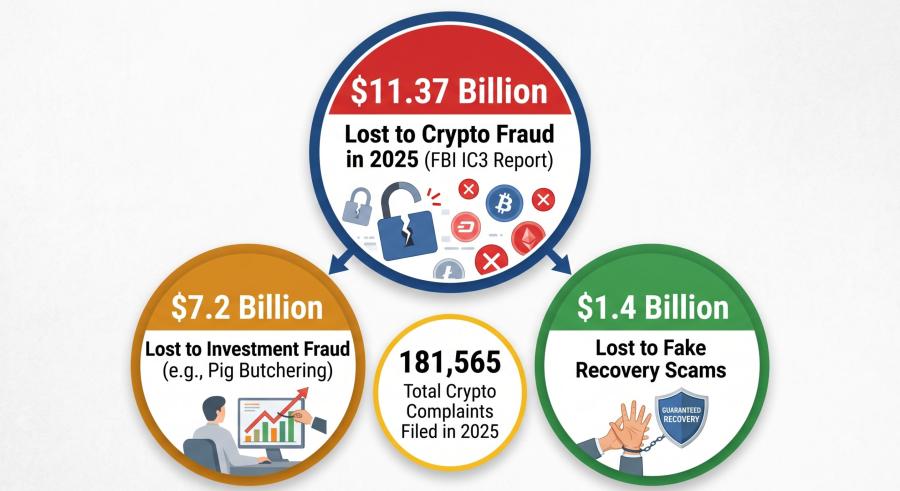
Americans lost $11.37 billion to cryptocurrency fraud in 2025 — accounting for more than half of all internet crime losses reported to the FBI. The scams are getting smarter, utilizing advanced AI and deeply manipulative tactics. This comprehensive guide breaks down exactly how each scam works, shares real victim stories, and provides step-by-step protection tools to keep your digital assets safe.
The 5 Most Critical Warnings
- Never share your seed phrase with anyone — ever. No legitimate service or support agent will ask for it.
- Run every unfamiliar platform through ScamAdviser.com and a WHOIS domain-age lookup before depositing a single dollar.
- Investment fraud (pig butchering) caused $7.2 billion in losses in 2025 — more than any other category.
- AI deepfake scams using fake celebrity videos are the fastest-growing new threat in 2026.
- If someone contacts you after you've been scammed promising to recover your funds for a fee, that is a recovery scam.
Crypto Fraud by the Numbers (2025 FBI Data)
Why Crypto Scams Are So Hard to Fight
Cryptocurrency transactions are irreversible by design. Unlike a credit card purchase or a wire transfer, there is no bank fraud department, no chargeback mechanism, and no centralized authority that can undo a completed blockchain transaction. The moment you sign the wrong contract or send funds to the wrong address, the money is permanently gone.
Furthermore, the tooling available to criminals has advanced dramatically. In 2026, scammers routinely utilize:
- AI-generated deepfake videos of prominent figures (e.g., Elon Musk, Michael Saylor) promoting fraudulent platforms.
- Automated AI chatbots capable of managing romantic or platonic "pig-butchering" relationships at scale.
- Fake review networks seeding AI-written 5-star testimonials across platforms like Trustpilot.
- Visual clones of legitimate exchanges that look identical down to the pixel.
Deep Dive: The 9 Major Scams Explained
1. Wallet Draining Scams
A wallet drainer is a highly sophisticated attack. It begins when you land on a malicious website—often a convincing fake of a popular NFT mint, a token airdrop, or a DeFi exchange. The site prompts you to "Connect Wallet" and then asks you to click "Approve." By clicking approval, you are digitally signing a malicious smart contract that grants the attacker permission to transfer assets out of your wallet. Automated scripts sweep every token, NFT, and coin out of your account in milliseconds.
Critical Warning: Before clicking "Approve" on any smart contract interaction, pause and read the full transaction details in your wallet interface. Legitimate mints and DeFi protocols do not need permission to transfer arbitrary amounts of assets you didn't explicitly select.
2. Pig Butchering Investment Fraud
Responsible for $7.2 billion in reported losses in 2025 alone, pig butchering (shā zhū pán) involves international organized crime syndicates building intense emotional trust with a victim before convincing them to invest in a fraudulent crypto platform.
The scam follows a strict psychological playbook:
- Initial contact: A "wrong number" text, LinkedIn connection, or dating app match.
- Relationship building: Weeks or months of daily messaging and emotional bonding.
- The introduction: The scammer casually highlights the massive returns they are making on a specific crypto platform.
- The "small wins": The victim invests a small amount, sees fake profits on a dashboard, and successfully withdraws a small test amount to manufacture trust.
- The bleed: The victim invests their life savings. When trying to withdraw, the platform demands escalating "taxes" or "compliance fees" until the victim runs out of money and the scammer cuts contact.
Real Victim Case Study: > A 58-year-old retired teacher in Ohio lost $83,000 after an 11-week online friendship with a contact claiming to be a finance professional. Her fake dashboard showed her $40,000 investment grow to $180,000. When trying to withdraw funds for her grandson's tuition, the platform demanded $43,000 in sequential "tax compliance" and "regulatory clearance" fees before her family intervened.
3. Fake Tokens & Rug Pulls
Because creating a crypto token takes less than an hour, scammers build slick branding, use stock photos for fake "doxxed" team members, and engineer social media hype to trigger FOMO (Fear Of Missing Out).
Classic Rug Pull: Developers attract millions of dollars into a project's liquidity pool, then abruptly withdraw all backing funds, rendering the token instantly unsellable.
The Slow Rug: The team gradually drains value over months by selling off their pre-mined allocation bit by bit until they quietly abandon the project.
4. Clipboard Hijackers & Address Poisoning
Clipboard Hijackers: Silent malware that infects your computer or phone. When you copy a crypto address, the malware instantly replaces it in your clipboard with the attacker's address.
- Address Poisoning: Attackers use automated tools to create a wallet address that matches the first 4–6 and last 4–5 characters of your wallet. They send a $0 or microscopic transaction to your wallet so their address appears in your history, betting that you will accidentally copy their address from your recent history next time.
5. Fake Crypto Support & Phishing
If you post a complaint about an exchange or wallet on X, Discord, or Reddit, automated bots and human scammers will instantly DM you pretending to be "support agents." They will direct you to a portal that looks identical to the real service and ask you to "sync" your wallet by entering your seed phrase.
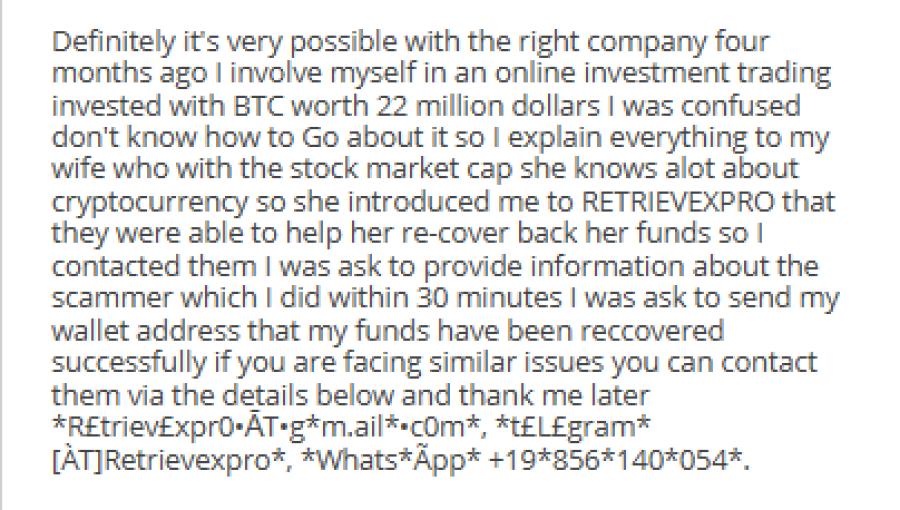
The Golden Rule: No legitimate wallet provider, exchange, or tech support agent will EVER ask for your seed phrase. Your seed phrase is the master key to your entire blockchain identity. Sharing it gives the recipient total, permanent ownership of your assets.
6. Crypto Recovery Fraud (The Double Loss)
After a victim publicly posts about being scammed, fake "law firms" or "blockchain investigators" target them. They charge hefty upfront fees, claiming they can hack the scammer or force a blockchain reversal. They cannot. No private entity can reverse a blockchain transaction. This results in a secondary financial blow to an already vulnerable victim.
7. Unwitting Money Laundering
If you accept peer-to-peer (P2P) crypto payments or freelance payments from unverified individuals, you may accidentally receive funds tied to a hack or exploit. When you try to move those funds to a regulated exchange like Coinbase or Binance, compliance algorithms will flag the history of those coins, freezing your account indefinitely.
8. AI Deepfakes & Celebrity Endorsements
This is the fastest-growing threat in 2026. Scammers use consumer-grade AI video tools to create hyper-realistic deepfakes of public figures like Elon Musk endorsing fake high-yield investment programs.

Live Video Call Manipulation: Syndicates are now using real-time AI video manipulation during video calls to impersonate financial advisors to fool high-value targets.
9. Honeypot Tokens
A honeypot is a token encoded with malicious smart contract rules that allow anyone to buy the token, but blocks anyone except the creator from selling it. The chart looks incredibly green and healthy because no one can sell, pumping up fake value until the creator pulls the plug.
How to Check Any Crypto Site With ScamAdviser
ScamAdviser is an invaluable free tool that analyzes dozens of technical signals to score a website’s legitimacy from 0 to 100.
What ScamAdviser Analyzes:
- Domain Registration Age: Flags platforms claiming to exist for years but whose website was registered days ago.
- Hidden Ownership: Identifies when site owners hide behind anonymity proxies in high-risk jurisdictions.
- Server Locations: Cross-references if a "US-regulated platform" is actually hosted on servers in high-risk foreign locations.
- Blacklist Status: Cross-references against global phishing and consumer protection databases.
Your Step-by-Step Verification Guide:
- Copy the exact URL of the crypto platform you are evaluating.
- Go to ScamAdviser.com and paste the URL into the search bar.
- Review the trust score: Below 70 requires extreme caution; below 40 is a serious red flag; below 20 is almost certainly a scam.
- Check the domain registration date to see if it matches the platform's claimed history.
- Cross-check the link independently using an official ICANN WHOIS lookup tool (lookup.icann.org).
12-Step Crypto Protection Checklist
- Get a Hardware Wallet: Keep major assets on a cold storage device (like Ledger or Trezor). Your seed phrase must never touch an internet-connected device.
- Use a Burner Wallet: Use a secondary, separate wallet containing minimal funds when interacting with new dApps, NFT mints, or airdrops.
- ScamAdviser Every New Site: Spend 30 seconds running any unfamiliar platform through ScamAdviser.
- Check Domain Age via WHOIS: Use lookup.icann.org to check the creation date of a platform's domain.
- Revoke Wallet Permissions Monthly: Routinely visit Revoke.cash to clean up and delete approved smart contract access to your wallet.
- Verify Full Addresses: Check every character of a wallet address before hitting send—never trust just the first and last few digits.
- Distrust Online Financial Advice: Treat any investment recommendation from someone you met online as a pig butchering attempt until proven otherwise.
- Analyze Celebrity Videos: Look for unnatural blinking, audio sync delays, or waxy textures that signal an AI deepfake.
- Bookmark Official URLs: Navigate to crypto exchanges exclusively using your own saved bookmarks. Never click direct links in emails or text messages.
- Enable Anti-Phishing Codes: Set up personalized phrases/codes in your exchange settings so you know emails from them are authentic.
- Install a Transaction Simulator: Use browser security extensions like Pocket Universe, Fire, or Wallet Guard to see what a transaction does before you sign it.
- Report Fraud Instantly: If targeted, report the details immediately to the FBI's Internet Crime Complaint Center at ic3.gov.
How Law Enforcement is Fighting Back
The FBI has transitioned to a highly proactive model to counter automated crypto threats through two primary operations:
- Operation Level Up: Launched in 2024, the FBI proactively tracks live pig-butchering operations using blockchain analytics. Instead of waiting for a report, agents identify victims mid-scam and contact them directly to warn them before they transfer life savings. This initiative has protected over 8,000 victims and saved more than $500 million.
- Operation Winter SHIELD: Launched in 2026, this newer initiative focuses on providing businesses and individuals with proactive, actionable defense structures to mitigate AI-driven phishing, deepfakes, and crypto-stealing malware.
Frequently Asked Questions
What is the most financially devastating crypto scam right now?
Investment fraud, primarily pig butchering, causes the largest financial losses. The FBI's data shows it accounted for $7.2 billion of all crypto fraud losses, driven by individual victims routinely losing their entire retirement or life savings to long-term psychological manipulation.
Can a stolen crypto transaction be reversed?
No. The underlying architecture of blockchain technology dictates absolute immutability. Once a transaction is confirmed on-chain, it cannot be altered or reversed by any bank, court, or government entity.
What should I do immediately if my wallet is drained?
Treat that specific wallet address as permanently compromised and stop using it.
Securely transfer any remaining tokens to a brand-new wallet address created on a clean device.
Go to Revoke.cash and wipe out all smart contract approvals on the old wallet.
Submit the attacker's wallet addresses to blockchain analytics firms like Chainalysis (reportscam@chainalysis.com).
File an official complaint detailing transaction hashes and communications at ic3.gov.
Ignore any direct messages from individuals claiming they can recover your funds.
Disclaimer: This article is for educational purposes only and does not constitute financial or legal advice. Cryptocurrency investments carry significant inherent risk. Last verified and updated: June, 2026.
Adam Collins is a cybersecurity researcher at ScamAdviser who operates under a pseudonym for privacy and security. With over four years on the digital frontlines, he specialises in translating complex threats into actionable advice. His mission: exposing red flags so you can navigate the web with confidence.
Report a Scam!

Have you fallen for a hoax, bought a fake product? Report the site and warn others!
Scam Categories
Help & Info
Top Safety Picks
Your Go-To Tools for Online SafetyDisclaimer: Some of the links here are affiliate links. If you click them and make a purchase, we may earn a commission at no extra cost to you.
- ScamAdviser App : That site looks legit. That's exactly how they get you. Modern scams are frighteningly convincing. ScamAdviser scans sites and blocks fraud calls automatically. Free on iOS & Android.
- NordVPN : NordVPN delivers powerful, seamless protection for your online life - whether you're at home, on public Wi-Fi, or traveling abroad. Recognized as one of the fastest VPN services available, it combines lightning-fast speeds with advanced encryption to keep
- Incogni : Incogni automatically removes your personal data from data brokers that trade in personal information online, helping reduce scam and identity theft risks without the hassle of manual opt-outs. Reclaim your privacy now!
- Private Internet Access (PIA) : PIA gives you a no-logs VPN built on the latest encryption standards and WireGuard protocol — meaning your browsing activity stays yours alone. Fast, private, and transparent. Take back your privacy today!
- Surfshark VPN : One subscription, unlimited devices. Surfshark is the fastest VPN out there — covering your phone, laptop, tablet and more with a stable, secure connection for browsing, streaming and working. Get Surfshark now!
- Proton VPN : Independently audited and built with a strict no-logs policy, Proton VPN is trusted by over 3 million users worldwide. It’s been named Best VPN by Wired, PCMag, and Vice—offering strong encryption for anyone who takes their privacy seriously. Give Proton
- Mysterium VPN : MysteriumVPN gives you real privacy without relying on a single company to protect it. Built on a decentralized network of independent nodes across the globe, it hides your traffic from ISPs, trackers, and the VPN provider itself. Choose data center IPs f
Popular Stories
In a nutshell: A good VPN protects your privacy with strong encryption, a strict no-logs policy, and fast protocols like WireGuard. The best VPNs also offer wide server coverage, leak protection, and easy-to-use apps for all devices. For 2025, the top providers are NordVPN, ExpressVPN, Surfshark, Proton VPN, Private Internet Access, CyberGhost, and Mullvad—each excelling in speed, security, or value. In an age where every click is tracked, a Virtual Private Network (VPN) is no longer just a luxury—it's an essential tool for digital privacy and security. A VPN works by creating a secure, encrypted tunnel between your device and the internet, masking your real IP address and protecting your sensitive data from prying eyes. But with hundreds of providers out there, how do you sort the secure from the suspect? This guide breaks down the non-negotiable features of a quality VPN and highlights the 7 top-rated services for 2025. What to Look for in a Good VPN: The 4 Non-Negotiable Pillars 1. Ironclad Security Features Strong Encryption: AES-256, the gold standard. Secure Protocols: OpenVPN, WireGuard, NordLynx, Lightway. Avoid PPTP. Kill Switch: Ensures no accidental IP leaks. Leak Protection: Covers DNS, IPv6, and WebRTC. 2. Verified Privacy Practices No-Logs Policy: No activity or metadata tracking. Independent Audits: Verification by third parties. Safe Jurisdiction: Prefer countries outside the 5/9/14 Eyes alliances. 3. High-Speed Performance Fast Protocols: WireGuard and equivalents. Large Server Network: Less crowding, more reliable speeds. 4. Essential Usability Features Multi-Device Apps: Windows, Mac, iOS, Android, routers. Simultaneous Connections: One account, many devices. Unblocking Power: Netflix, Hulu, BBC
This article has been updated by Jamie James on June 9 with the latest data and analysis we have found using real user reports and experiences submitted to ScamAdviser. Just received that terrifying notification? Or perhaps you've noticed suspicious activity in your accounts? Take a deep breath. Your email, password, phone number, home address, payment details, or identity documents may now be in places you cannot control. But the next steps do not have to be confusing. What matters most is how quickly you act, order, and know which exposed data creates the biggest risk. This guide explains what to do after a data breach, how to check the damage, and how to protect yourself from identity theft, account takeover, and follow-up scams. Quick Summary Verify the data breach notice through the company’s official website before clicking any links. Secure your primary email account first because it controls many password resets. Change the exposed password and every reused or similar password. Enable multi-factor authentication on email, banking, payment, cloud, and social accounts. Contact your bank or card issuer if payment or bank account details were exposed. Freeze or protect your credit if sensitive identity information was compromised. Watch for phishing messages, fake refund offers, and scam websites that use your leaked details. Starting with Data Breach Numbers The numbers don't lie: according to a 2024 report, the number of data breach victim notices has grown by a staggering 211% year-over-year. This isn't just a distant threat; it's a stark reality many individuals fa