
WWE Wrestler Roman Reigns Death News: Real or Fake?

Author: De-Reviews.com Team
Today, we’re looking at a rumor that’s going around on social media like Facebook, TikTok, and Reels. The claim says that Roman Reigns, one of WWE’s biggest stars, has died in a car accident. But is this true? Let’s break it down.
Who Is Roman Reigns?
Leati Joseph Anoaʻi, ring name Roman Reigns, was born on May 25, 1985, in Pensacola, Florida, is a prominent American professional wrestler, actor, and former football player. He comes from the legendary Anoaʻi wrestling family, with his father Sika Anoaʻi being a well-known wrestler.
Before stepping into the wrestling ring, Roman played college football at Georgia Tech and had brief stints in the NFL and Canadian Football League. He signed with WWE in 2010, made his main roster debut in 2012, and quickly rose to become one of the company’s biggest stars. Standing 6 ft 3 in (191 cm) and weighing 265 lb (120 kg), he is known for his commanding presence, signature moves like the Spear, and captivating persona as “The Head of the Table”.
Over his career, Roman Reigns has held multiple championships, including a historic WWE Universal Championship reign of 1,316 days, and has established himself as one of the top wrestlers of his generation. Outside the ring, he is married to Galina Becker and is a father of five children.
Fact Checking About Roman Reigns Death News:
No Credible News Coverage:
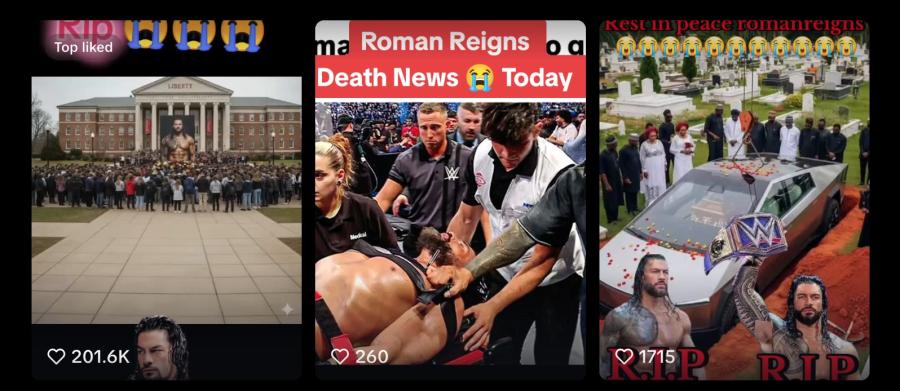
Despite the viral posts on social media like TikTok and Instagram Reels, no reputable news outlet has reported the death of Roman Reigns. Major sports and entertainment news platforms have not confirmed any such incident.
No WWE Statement:
WWE, the official organization behind Roman Reigns, has not released any announcement or confirmation regarding the rumor.
Active in Recent Events:
Roman Reigns has been actively participating in recent WWE shows, matches, and appearances, which clearly proves he is alive.
Classic Death Hoax:
The claim is a typical death hoax, designed to create panic, attract attention, and spread misinformation across social media platforms.
Emotional Virality:
These hoaxes gain traction quickly because fans react emotionally, but checking official sources and verified news always reveals the truth.
Why These Hoaxes Spread So Quickly?
With a superstar like Roman Reigns, who has a massive global fan base and a strong presence on social media, false claims can spread extremely quickly. Fans around the world closely follow his every move, and any shocking news about him naturally triggers strong emotional reactions. When people encounter alarming stories about their beloved star, they often share them immediately, sometimes without checking the source or verifying the facts.
Then this rapid sharing becomes viral, allowing the false claim to reach thousands or even millions of people in a short time. Unfortunately, this is exactly how many celebrity death hoaxes gain momentum online before anyone takes the time to confirm whether the news is real.

Final Word:
To sum up, Roman Reigns (Leati Joseph Anoaʻi), is very much alive and actively continuing his professional wrestling career. The recent claims about his car accident or death are unverified and lack any credible evidence. Fans and social media users should remain cautious when encountering shocking news about celebrities.
Verifying Before Believing:
Before getting carried away by social media, it’s important to verify information. Check official sources and trusted news outlets rather than believing everything you see online. Rumors like this can spread fast, but the truth is usually different from what the posts claim.
Reference:
Image Sources:
Report a Scam!

Have you fallen for a hoax, bought a fake product? Report the site and warn others!
Scam Categories
Help & Info
Top Safety Picks
Your Go-To Tools for Online Safety
- ScamAdviser App - iOS : Your personal scam detector, on the go! Check website safety, report scams, and get instant alerts. Available on iOS
- ScamAdviser App - Android : Your personal scam detector, on the go! Check website safety, report scams, and get instant alerts. Available on Android.
- NordVPN : NordVPN keeps your connection private and secure whether you are at home, traveling, or streaming from another country. It protects your data, blocks unwanted ads and trackers, and helps you access your paid subscriptions anywhere. Try it Today!
Popular Stories
As the influence of the internet rises, so does the prevalence of online scams. There are fraudsters making all kinds of claims to trap victims online - from fake investment opportunities to online stores - and the internet allows them to operate from any part of the world with anonymity. The ability to spot online scams is an important skill to have as the virtual world is increasingly becoming a part of every facet of our lives. The below tips will help you identify the signs which can indicate that a website could be a scam. Common Sense: Too Good To Be True When looking for goods online, a great deal can be very enticing. A Gucci bag or a new iPhone for half the price? Who wouldn’t want to grab such a deal? Scammers know this too and try to take advantage of the fact. If an online deal looks too good to be true, think twice and double-check things. The easiest way to do this is to simply check out the same product at competing websites (that you trust). If the difference in prices is huge, it might be better to double-check the rest of the website. Check Out the Social Media Links Social media is a core part of ecommerce businesses these days and consumers often expect online shops to have a social media presence. Scammers know this and often insert logos of social media sites on their websites. Scratching beneath the surface often reveals this fu
Disclaimer: This article was originally published in 2018 and has been updated in October 2025 to reflect more current information, resources, and advice. Scams and recovery options continue to evolve, so always double-check with your bank, payment provider, or local consumer protection authority for the latest guidance. So the worst has come to pass - you realise you parted with your money too fast, and the site you used was a scam - what now? Well first of all, don’t despair!! If you think you have been scammed, the first port of call when having an issue is to simply ask for a refund. This is the first and easiest step to determine whether you are dealing with a genuine company or scammers. Sadly, getting your money back from a scammer is not as simple as just asking. If you are indeed dealing with scammers, the procedure (and chance) of getting your money back varies depending on the payment method you used. PayPal Debit card/Credit card Bank transfer Wire transfer Google Pay Bitcoin PayPal Good news: PayPal gives you strong protection. You can file a dispute within 180 days of your purchase. You can get a refund if: Your order never arrives, and the seller cannot provide proof of delivery. The scammer sends you something completely different (e.g., a controller instead of a PlayStation). The product condition was misrepresented (sold as new but arrives used). The item is missing undisclosed parts. The item is counterfeit. Start your claim directly through Pay