
Is SOYFIP a Scam? | Website Review
Author: James Greening
*Update*
After the publication of this review, we have been in correspondence with SOYFIP regarding the issues mentioned in the review that shed light of suspicion on the organization. However, SOYFIP has furnished proof that they indeed work with law enforcement in order to nab suspected pedophiles. Therefore, we believe that we can state with confidence that SOYFIP is NOT a scam, as they seem to genuinely work towards the cause of catching pedophiles.
*****************************************************************************************************************************************
Original review:
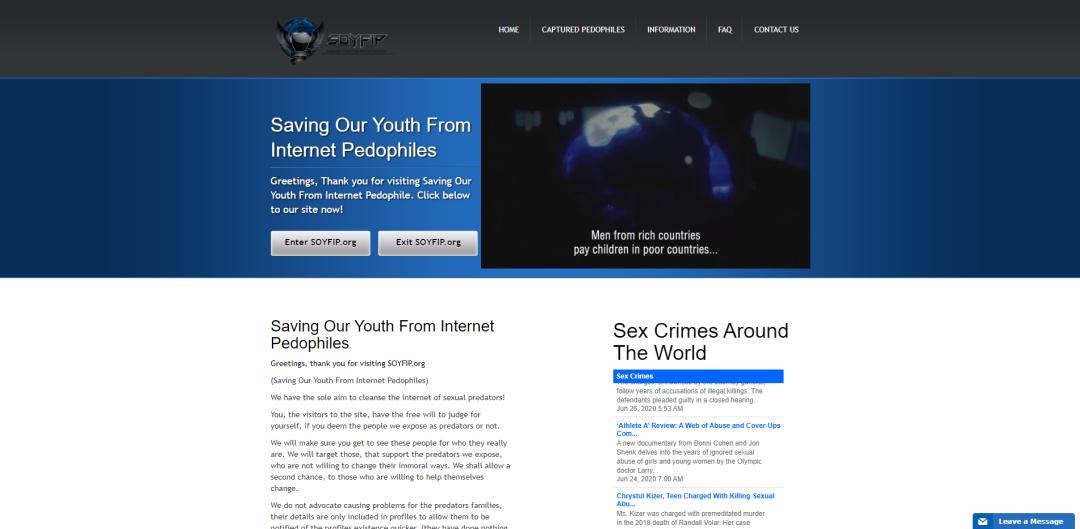
Saving Our Youth From Internet Pedophiles (SOYFIP) is an organization which claims to be creating a database of internet pedophiles. It seems to be a vigilante group with no affiliation to any law enforcement authority. The members of SOYFIP pose as minors online to catch pedophiles. The majority of the website traffic comes from USA and UK.
At the time of writing this article, there are 808 individuals included in their list of ‘captured pedophiles’. SOYFIP has published the names, photographs, chats logs and other redacted information of these individuals to serve as a reference. The idea is that anyone who suspects a person around them to be a pedophile can check SOYFIP’s website to confirm their suspicions. The details given on the website seem to be genuine as there is no evidence of the images or chat logs being copied from elsewhere.
Website Information
Official Domain
soyfip.org
Registered on
2014-08-21
Owner
Unknown
Only the information about the domain name and registration date is available as other details have been protected by a privacy guard.
Company Information
Email ID
Not Provided
Phone Number
Not Provided
Address
Not Provided
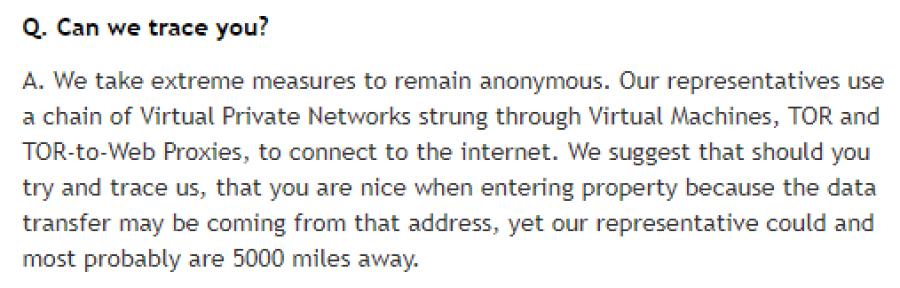
The only way to get in touch with SOYFIP is through their Live Chat Support System. SOYFIP has stated that they do not share any contact details to prevent their members from being traced.
Social Media Profiles
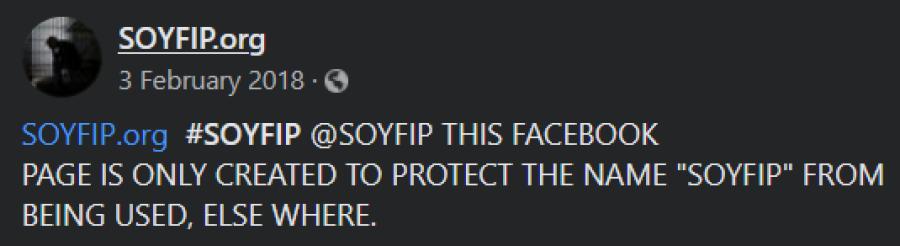
Facebook (Created on 3 February 2018): https://www.facebook.com/SOYFIP/
Twitter (Created on August 2015): https://twitter.com/soyfip
The justification given for not providing contact details is believable. There are no official social media profiles of SOYFIP listed on the website but some profiles were found on searching the websites directly. The social media pages are not active and only seem to have been created to prevent the name SOYFIP from being used by anyone else.
Scamadviser Verification
SOYFIP.org has been verified by Scamadviser as having a valid company registration and/or ID.
Imposters Pretending to be from SOYFIP?
On every page of the website, a pop-up appears after loading which states that any voice calls from SOYFIP should be ignored, as they never call anyone and threaten to publish personal information outside the website.
This suggests that there are scammers making phone calls to people pretending to be representatives of SOYFIP. The possible scam here could be that imposters are calling people up pretending to be SOYFIP with an intention to extort money. There is, of course, the possibility that SOYFIP might be threatening people about posting their names and photographs on the website, but there is no evidence that they are involved in such unscrupulous activities.
Suddenly receiving a call and being accused to pedophilia would no doubt scare anyone. No information could be found about such a scam as there is almost no information available about SOYFIP outside their website. Given the sensitive nature of the topic, people who have received such calls might be reluctant to post about it online.
Scamadviser Trust Score
Scamadviser’s algorithms have given SOYFIP a high Trust Score of 100%, indicating that users need not worry about using this website. You can learn more about SOYFIP’s Trust score here.
Scamadviser User Reviews
There is only one user review for SOYFIP posted on Scamadviser. The user has thanked them for saving the reviewer from a ‘sick pedophile’ and contains a link to the website. The account has only posted one review on Scamadviser and there is a possibility that this review could be fake due to reasons which are explained in the next section.
You can read the user review here.
External User Reviews
Reviews of SOYFIP are scarce. However, a number of reviews were found on the Web of Trust page of SOYFIP. This page has been claimed by the organization and they have replied to the reviews.
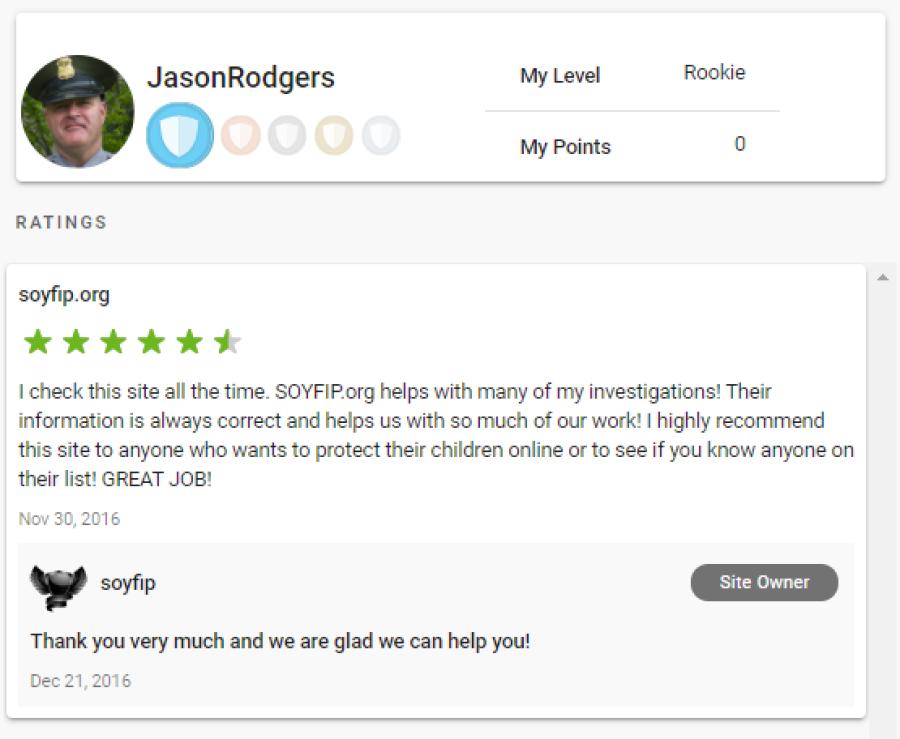
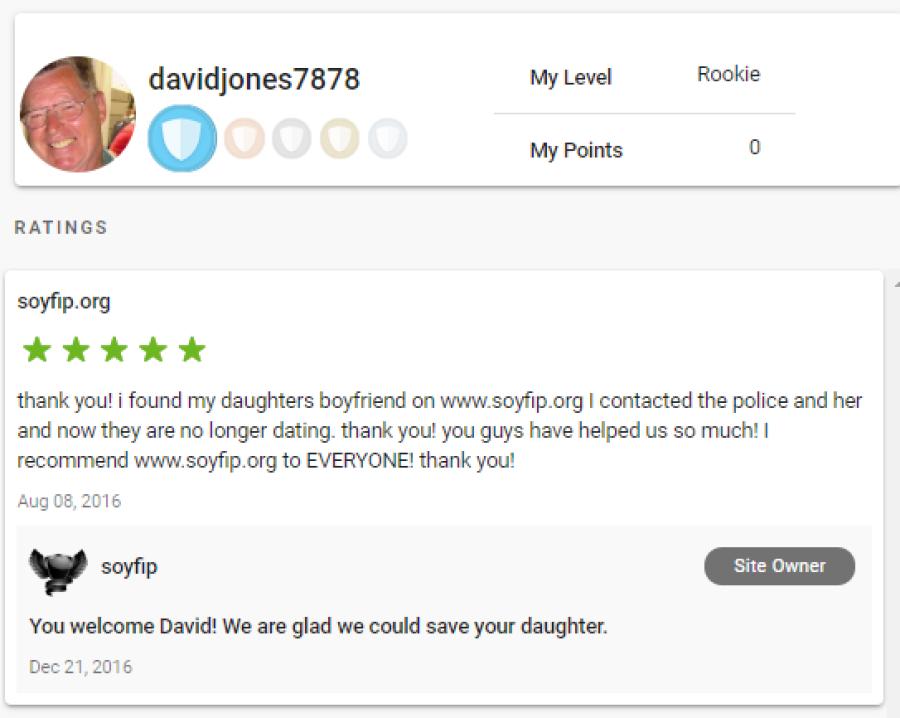
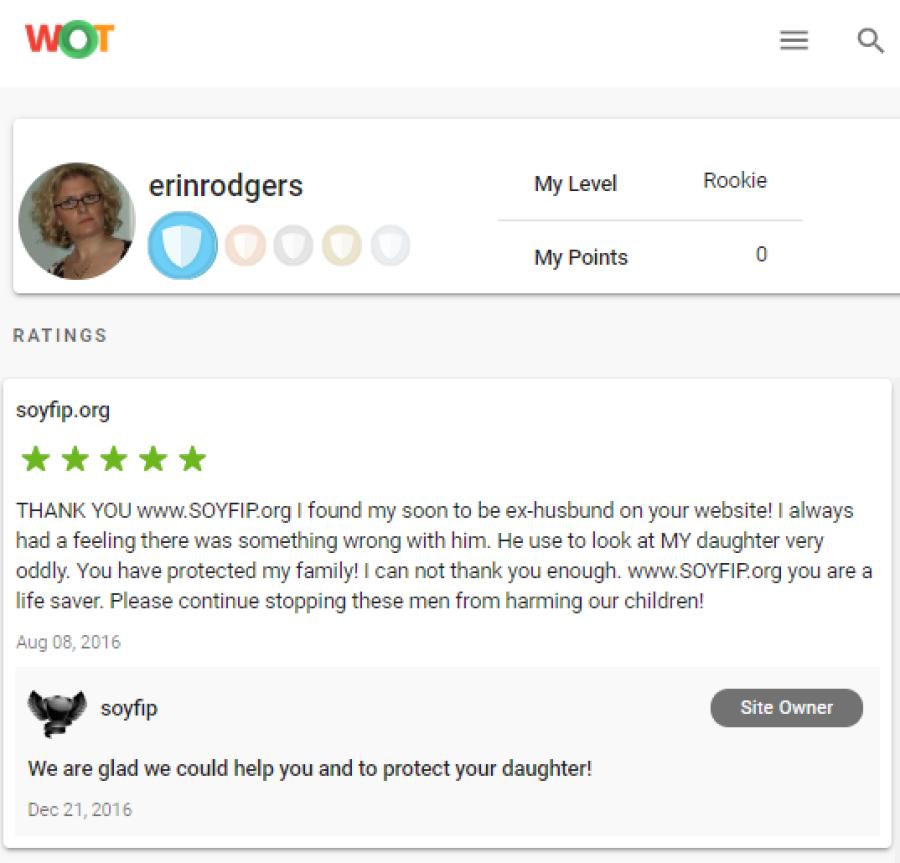
The WOT reviews are all positive and have awarded SOYFIP between 4.5 to 5 stars. These reviews seem to be fake due to three main reasons.
Reason 1: Suspicious Pattern
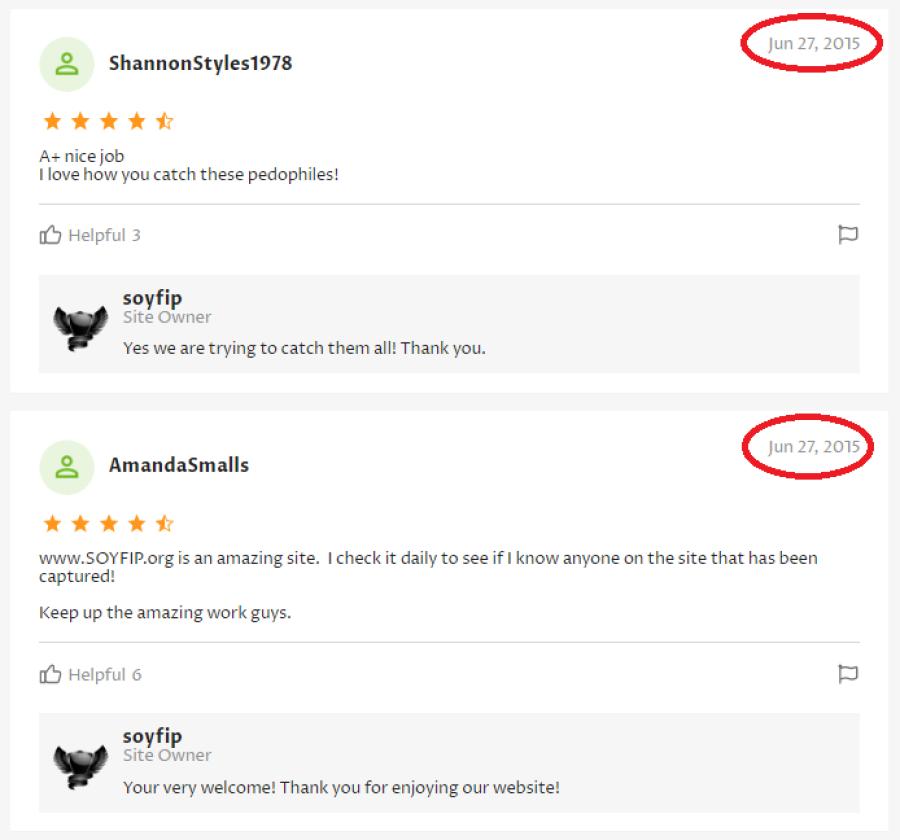
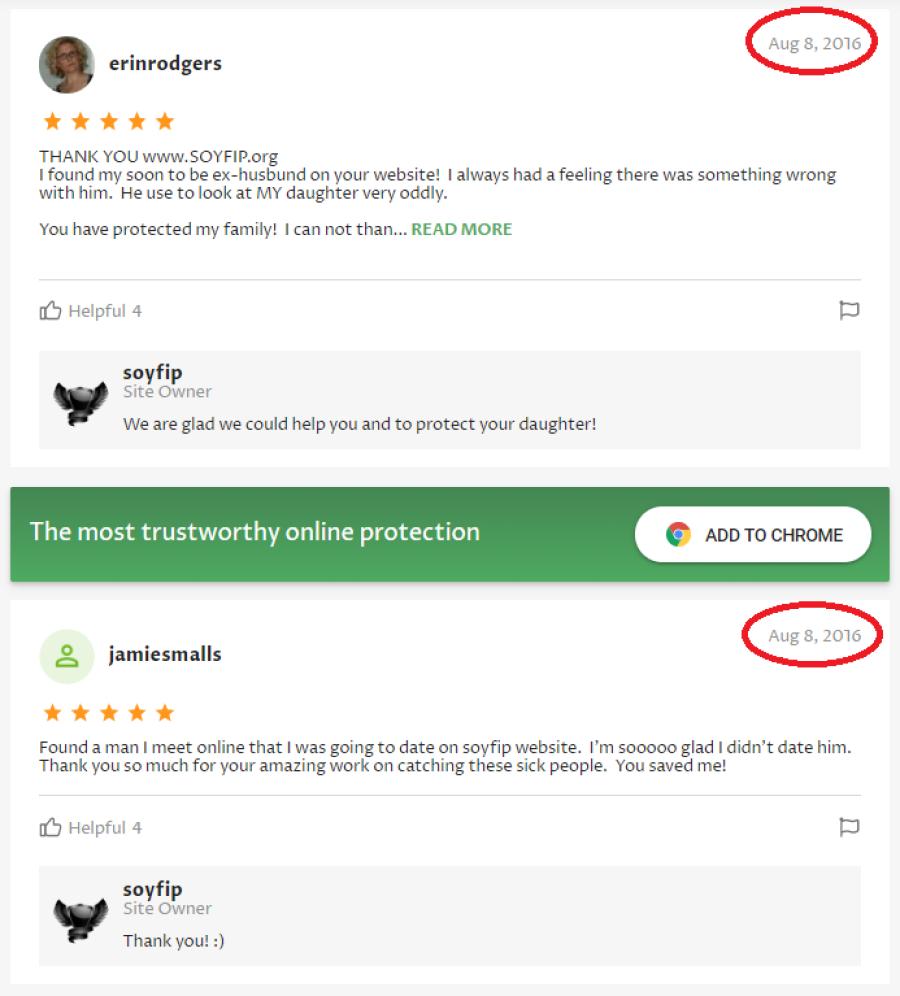
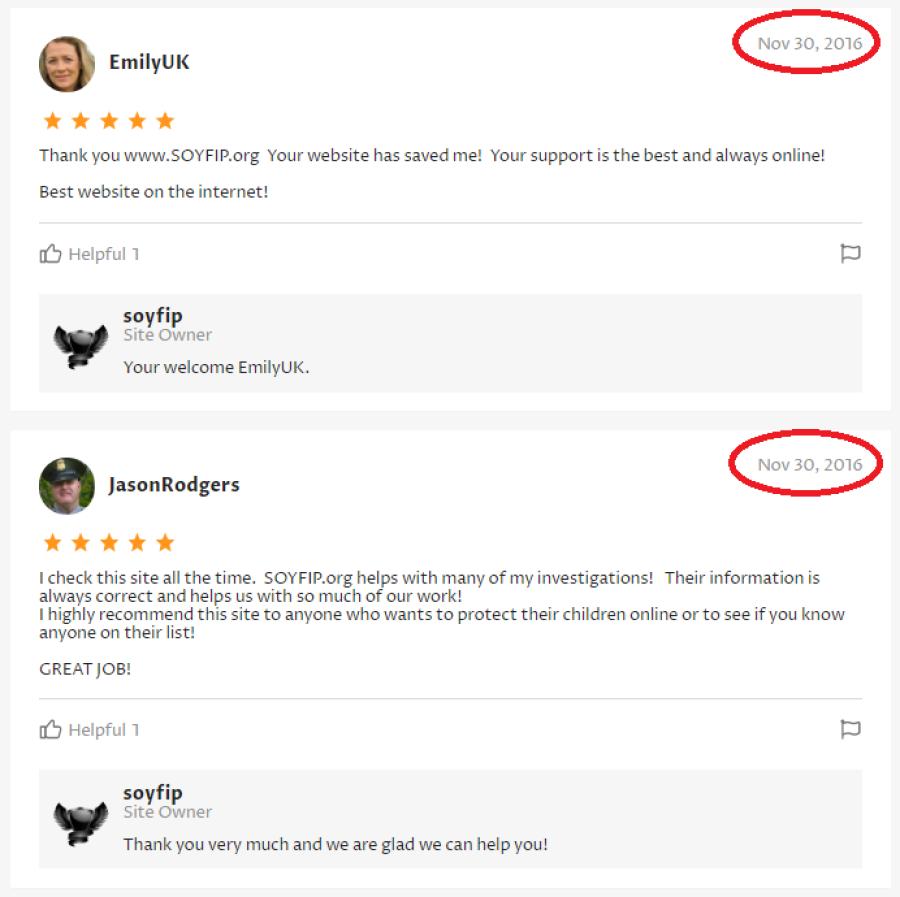
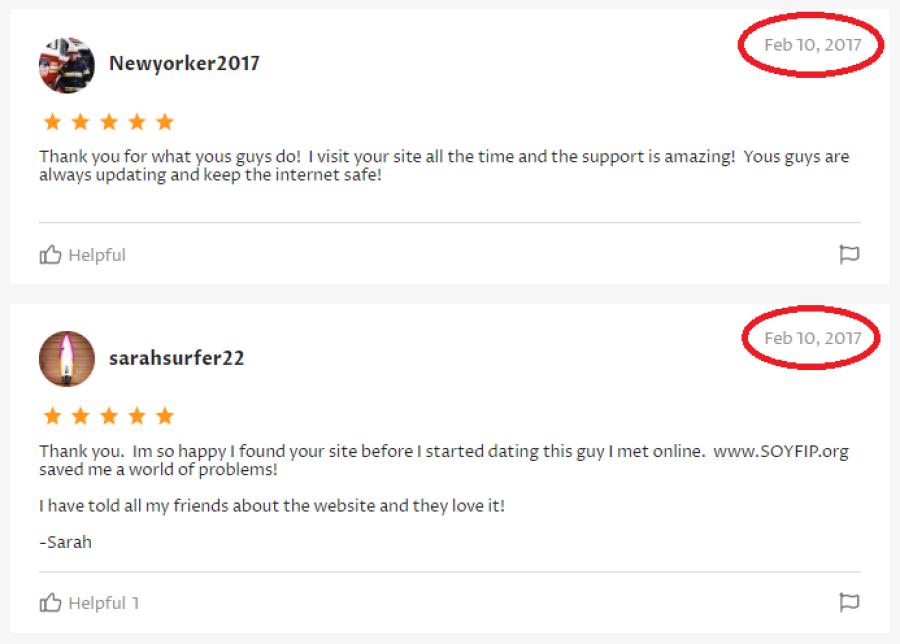
The first reason is that there is a suspicious pattern of two reviews being posted on the same day after long gaps.
Reason 2: Suspicious Accounts
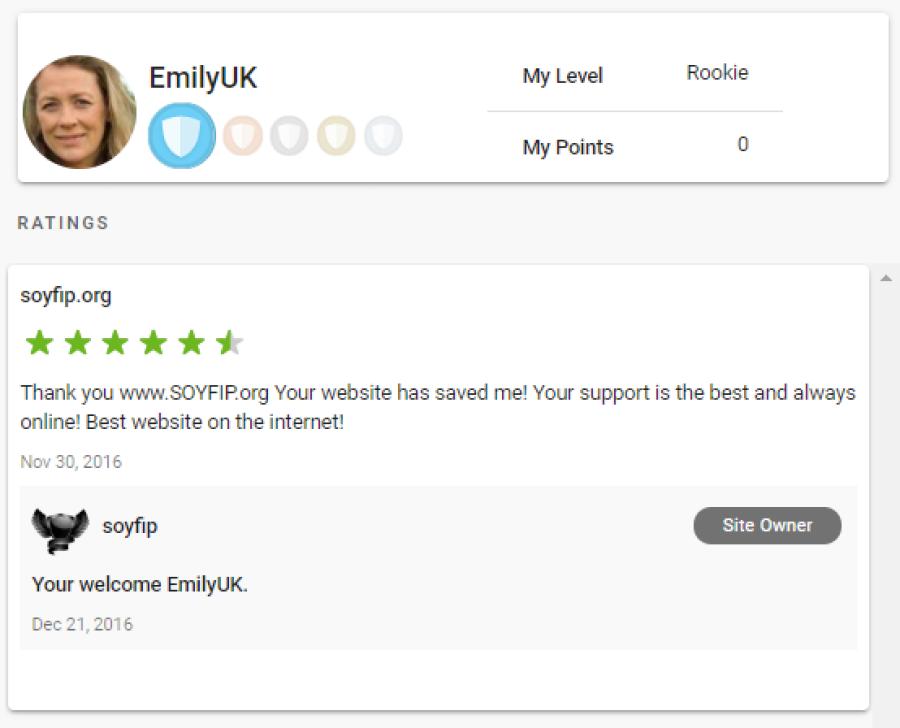
The second reason is that the profiles seem to be created for the sole purpose of leaving reviews for SOYFIP. The accounts are likely to be fake as the images used as the profile pictures can be found on other websites. Some of these websites contain the names of the people pictured and they don’t match the names used in the Web of Trust accounts.


Reason 3: Suspicious Language
The third reason is that the reviews don’t look like ones that real users would leave. All of them seem to be trying to present various ‘use cases’ of the website and 7 out of 11 reviews contain the link to the website. Real reviewers rarely include website links in their reviews. One of the reviewers has said that she visits the website every day to check if anyone she knows has been captured. It’s a really weird thing to say about a pedophile database, in my opinion.
To learn more about how you can spot fake reviews, visit the page How to Recognize Fake Reviews.
Conclusion
SOYFIP has a low likelihood of being a scam.
The website has an outdated design which can be attributed to the fact that it was created in 2014. The organization seems to be self-funded and is not soliciting donations on the website or on social media. They have prominently put up an alert on the website that they do not call up people or publicly release personal information. The suspicious WOT reviews might warrant a lowering of their Trust Score, but there is no evidence that the organization or the website pose any risks to ordinary internet users.
Learn More
Though there is no evidence that SOYFIP itself is running an extortion racket, it seems that impersonators are trying to blackmail people by branding them as pedophiles. These kinds of scams are known as ‘extortion scams’ and there have been many instances of people falling victim to these. To know how you can protect yourself from extortion scams, visit the page How to Recognize a Scam - Extortion Scams.
Dating scams are also a fairly common occurrence on the internet. Scammers pretend to have fallen in love with victims and ask for money under false pretences. To learn more about Dating/Romance Scams, visit the page Dating & Romance Scams.
Follow our social media channels for news about the latest scams and tips to stay safe online. We also invite you to join the growing community of scam fighters on our Facebook Group.
Report a Scam!

Have you fallen for a hoax, bought a fake product? Report the site and warn others!
Scam Categories
Help & Info
Top Safety Picks
Your Go-To Tools for Online SafetyDisclaimer: Some of the links here are affiliate links. If you click them and make a purchase, we may earn a commission at no extra cost to you.
- ScamAdviser App - iOS : Your personal scam detector, on the go! Check website safety, report scams, and get instant alerts. Available on iOS
- ScamAdviser App - Android : Your personal scam detector, on the go! Check website safety, report scams, and get instant alerts. Available on Android.
- NordVPN : NordVPN keeps your connection private and secure whether you are at home, traveling, or streaming from another country. It protects your data, blocks unwanted ads and trackers, and helps you access your paid subscriptions anywhere. Try it Today!
- Incogni : Incogni automatically removes your personal data from data brokers that trade in personal information online, helping reduce scam and identity theft risks without the hassle of manual opt-outs. Reclaim your privacy now!
Popular Stories
As the influence of the internet rises, so does the prevalence of online scams. There are fraudsters making all kinds of claims to trap victims online - from fake investment opportunities to online stores - and the internet allows them to operate from any part of the world with anonymity. The ability to spot online scams is an important skill to have as the virtual world is increasingly becoming a part of every facet of our lives. The below tips will help you identify the signs which can indicate that a website could be a scam. Common Sense: Too Good To Be True When looking for goods online, a great deal can be very enticing. A Gucci bag or a new iPhone for half the price? Who wouldn’t want to grab such a deal? Scammers know this too and try to take advantage of the fact. If an online deal looks too good to be true, think twice and double-check things. The easiest way to do this is to simply check out the same product at competing websites (that you trust). If the difference in prices is huge, it might be better to double-check the rest of the website. Check Out the Social Media Links Social media is a core part of ecommerce businesses these days and consumers often expect online shops to have a social media presence. Scammers know this and often insert logos of social media sites on their websites. Scratching beneath the surface often reveals this fu
How do I recover my crypto after it’s stolen? What happens if your crypto wallet is compromised? Can stolen crypto be traced, and can police actually recover crypto in 2026? These are the questions most people ask within minutes of realizing their wallet has been drained. Crypto theft is fast, quiet, and unforgiving. By the time most victims notice something is wrong, the funds are already moving across the blockchain. Once seen as a problem for exchanges and whales, crypto theft now heavily affects everyday investors. Phishing links, fake support chats, wallet approval scams, SIM swaps, and malware attacks have become common. Knowing what recovery realistically looks like—and what it doesn’t—can prevent panic, bad decisions, and costly follow-up scams. In a Nutshell Crypto recovery is possible, but only in limited situations Blockchain transactions are irreversible, but stolen crypto can still be traced Speed and documentation matter more than optimism Police and exchanges play a bigger role than private recovery services Guaranteed recovery offers are almost always scams Is it Actually Possible to Recover Stolen Crypto? Yes, crypto recovery is possible, but only under specific conditions and rarely through direct action by the victim. Blockchain transactions are final by design. Once crypto is sent and confirmed, it cannot be reversed. There is no central authority, no chargeback process, and no technical “undo” button, even if the transaction was clearly fraudulent. This is where many people ask whether stolen crypto can be traced. In most cases, it can. Every transaction