
COVID-19 Relief / Stimulus Check Scams: 6 Cases & 3 Steps to Stay Safe
Author: Trend Micro
All of us have been affected by COVID-19, and many of us are suffering financially as a result. And not too surprisingly, scammers are up to their usual tricks again and have been trying their very best to exploit this. Recently, we’ve seen lots of COVID-19 relief phishing scams designed to steal people’s personal information. Continue reading to learn how these scams work and how you can protect yourself:
How COVID-19 relief scams work
Posing as famous companies or government agencies, scammers send text messages with phishing links prompting people to apply for a COVID-19 relief program or to claim stimulus funds.
If you follow their instructions, you’ll be taken to a fake company or government website, or an online form, where you have to enter personal information, including your home address, social security number, bank details, or even copies of your IDs. Scammers record all this sensitive information and use it for identity theft!
6 cases to be wary of
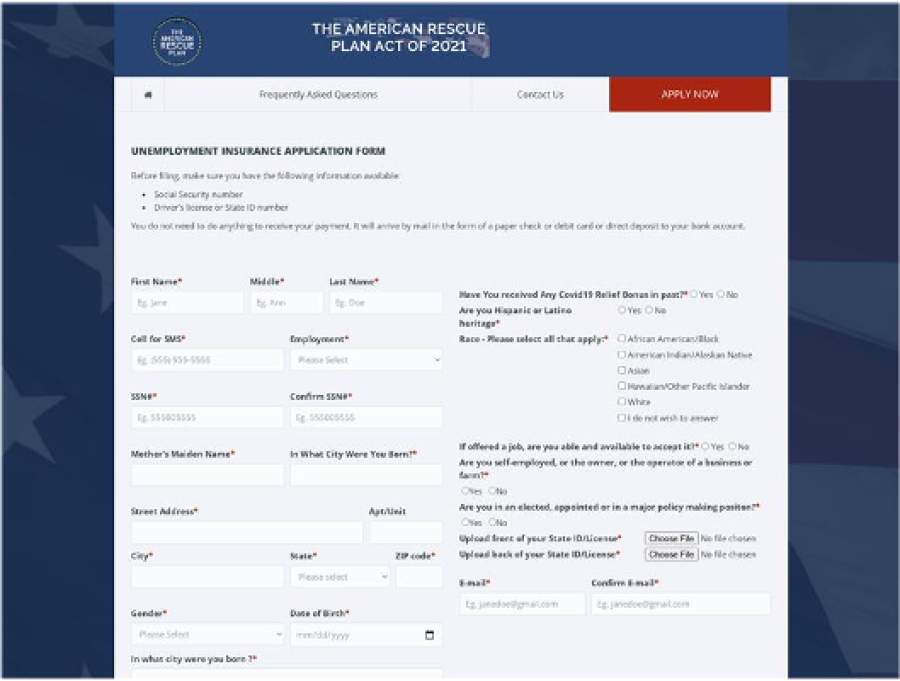
1. Fake American Rescue Plan Act of 2021
Phishing SMS content:
unemployment benefit alert!!! Apply for $1400 weekly benefit from american rescue now. start your online application today and visit the official american rescue website at https[:]//americanrelief-plan [.] com/
Safety Tip:
All payments made through the American Rescue Plan will be delivered to families in need automatically. Do not let scammers collect your personal information!
2. Fake Congress unemployment benefit scam
Phishing SMS content:
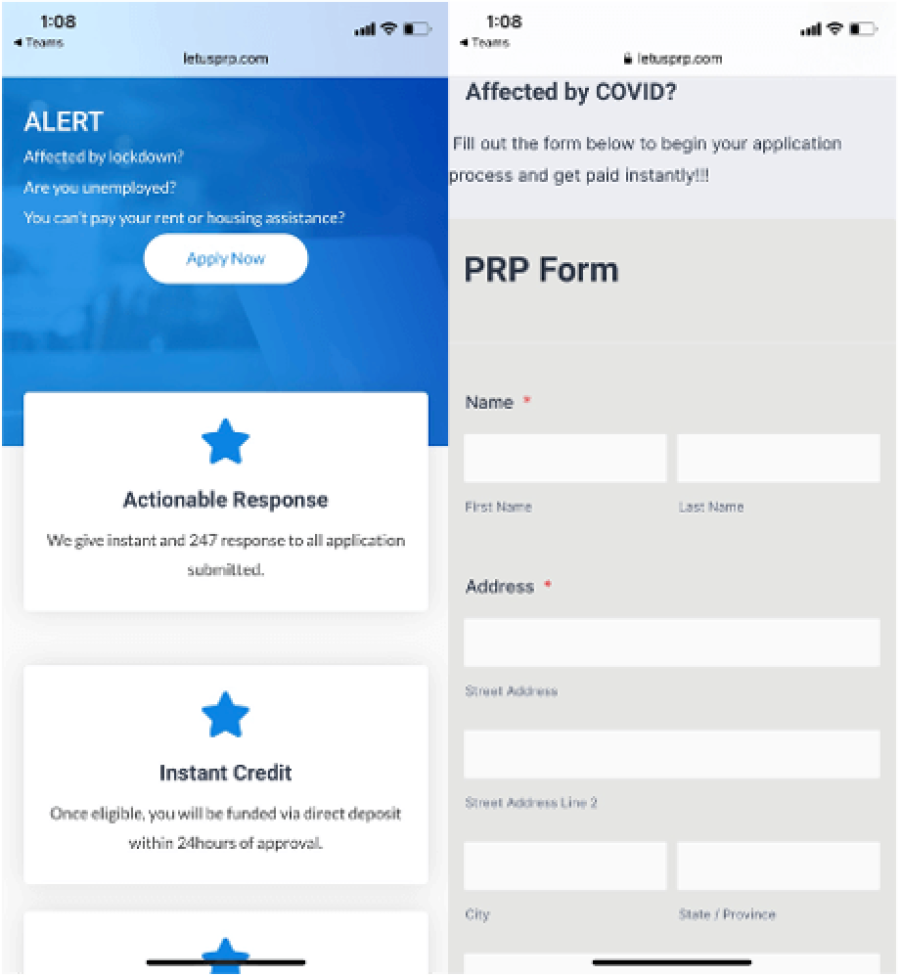
affected by covid-19? congress has finally agreed to the $900 billion stimulus plan to help americans and businesses to ease of coronavirus pandemic this includes student, business owners, self-employed workers, retired, disabled, independent contractors, and those with a limited work host who are out business or have significantly reduced their services as a direct result of the pandemic. to claim, go to <URL> after your claim, refer to our step-by-step claims process.
Safety Tip:
Always go to the US government’s official website for accurate information and help regarding unemployment and updates about unemployment benefits regarding COVID-19.
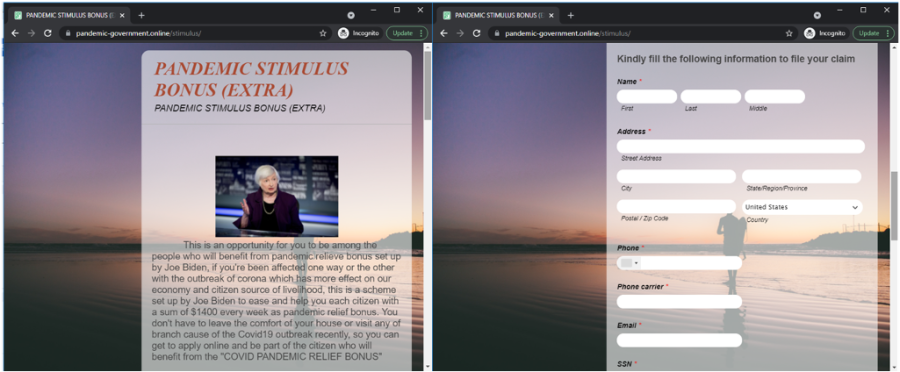
3. Fake US Government pandemic stimulus bonus
Phishing SMS content:
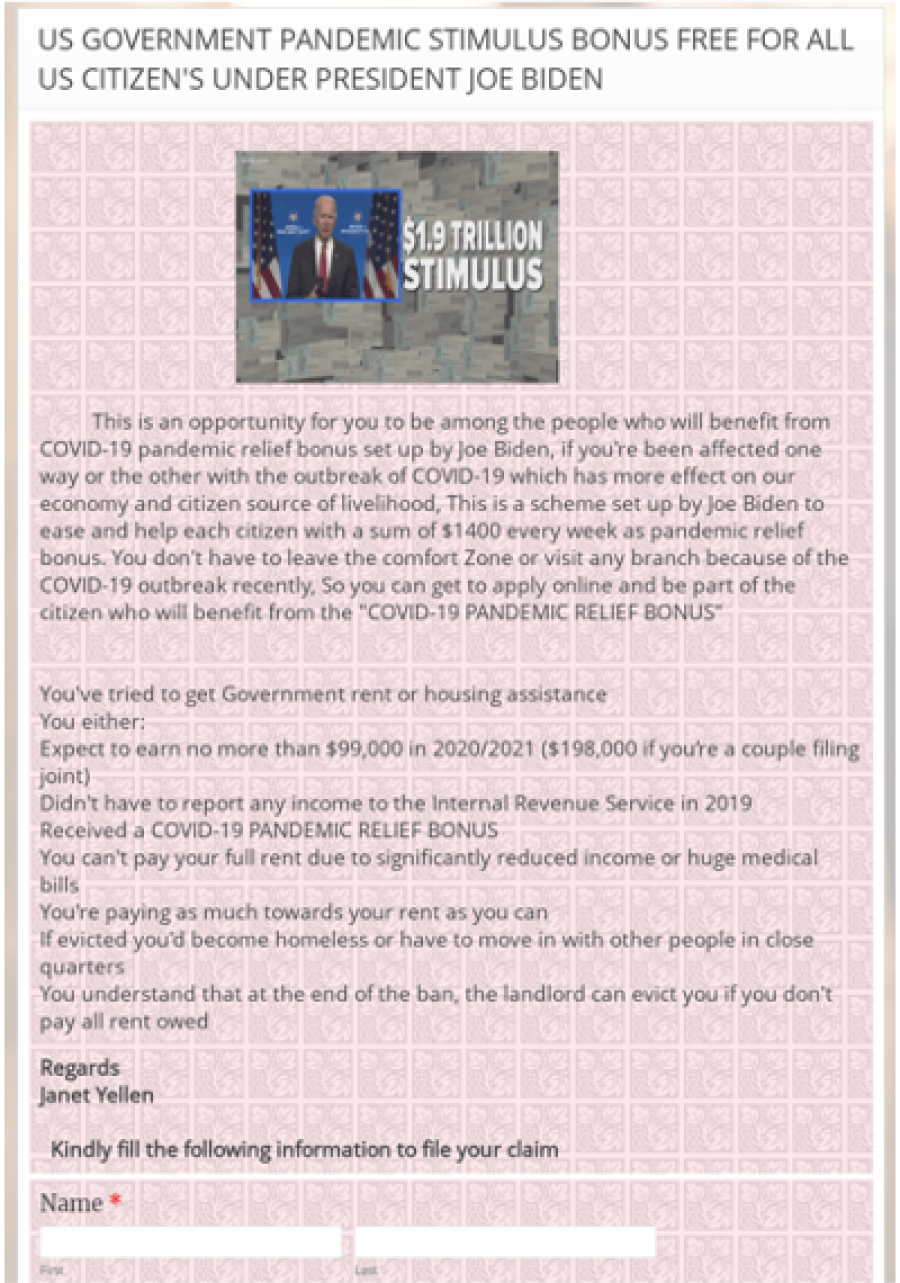
- US COVID-19 relief bonus”. This site ask user to provide some sensitive information like SSN, picture of your State ID/Driver’s License/International Passport URL: https [:] //mybenefit4you[ . ]com/9
- Congrats, We are pleased to inform you thatyour information was picked up for COVID-19 Stimulus payment from the Federal Govern-ment by JOE BIDEN You’reEligible to the payment. Kindly follow the linkto complete the form hxxps[:]//mybenefit4you[ .]com/9 When you’ve submitted your details,Bob Jewell from Employment Departmentwill contact you for more details on how youwill receive your money ASAP. Thanks Rita L.Saenz Director Employment Development
Safety Tip:
Please refer to the IRS and the US government’s websites for legitimate information aboutCOVID-19 stimulus checks for individuals. Don’t fall for fake ads or promotions about it.
4. US Department of State extra stimulus bonus phishing scam
Phishing SMS Content
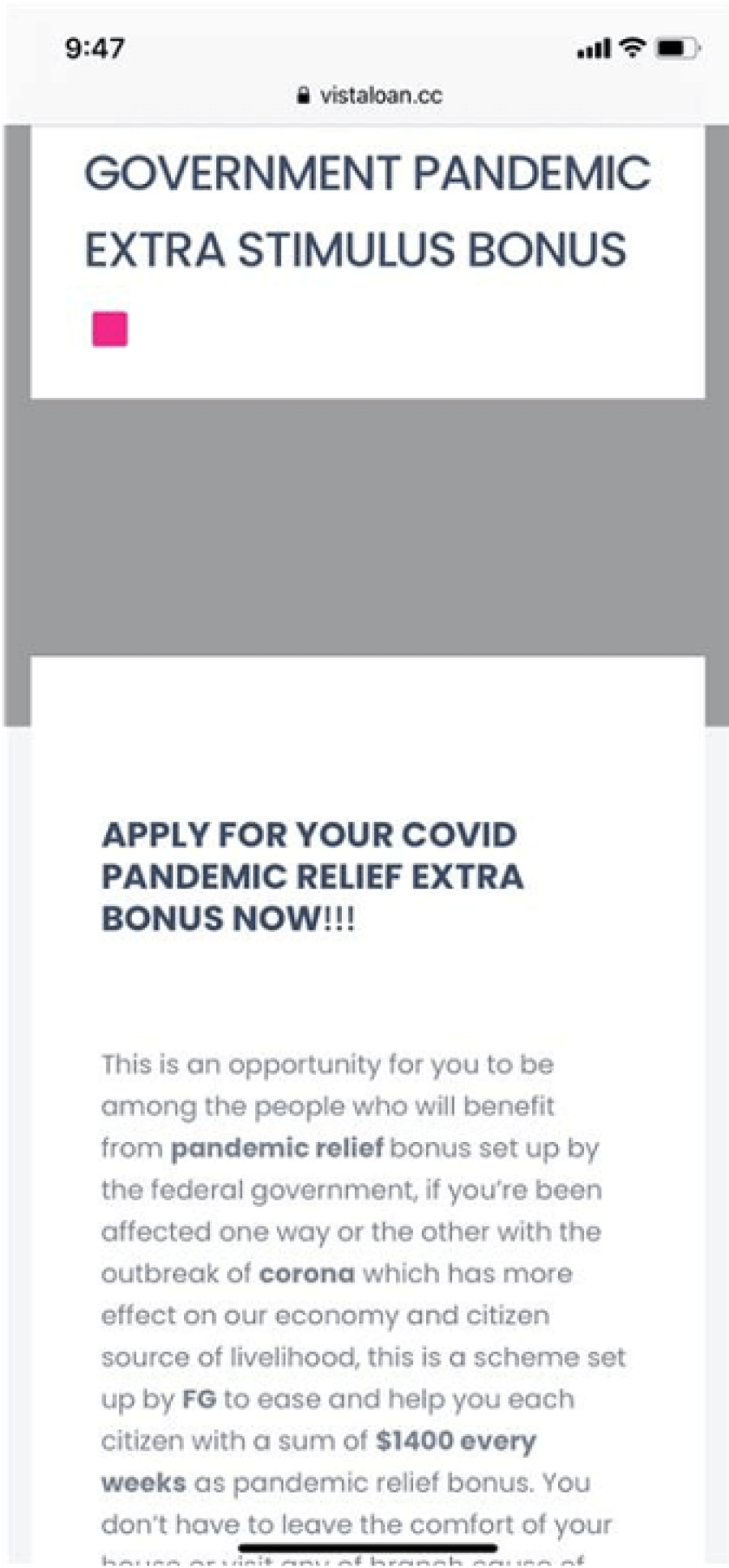
us department of state extra stimulus: get your covid-19 relief fund of $1,400 per-week for the next 26 weeks. for more details, please visit: https[:]//www.vistaloan [. ]cc/ index.php/covid-relief/
Safety Tip:
Again, don’t fall for fake ads or promotions about any stimulus bonuses. Please go to the US government’s website for legitimate information about COVID-19 stimulus checks for individuals.
5. Fake Direct Relief International website
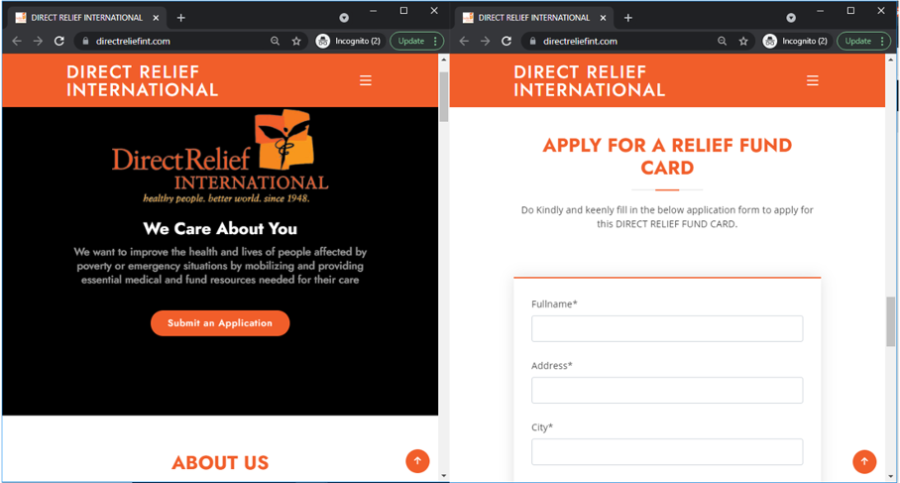
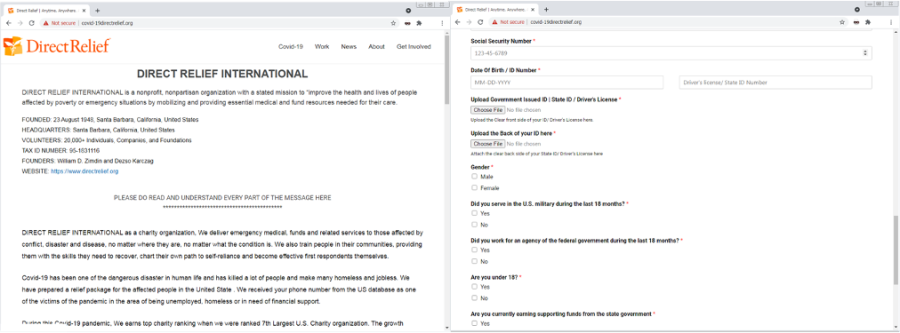
Sometimes scammers create fake websites designed to appear to be those of famous organizations. They might look similar to the genuine ones, but these pages are designed to record and steal your personal information.
Safety Tip:
Double-check the web address! The legitimate URL for Direct Relief International’s website is: https://www.directrelief.org/
6. Charitable pandemic relief stimulus check scam
Phishing SMS content
How are you? This is Kevin Chlan contacting you regarding the Covid Pandemic Relief stimulus check. Are you still interested in the free benefit? If you are I have voluntarily decided to donate the sum of $20,000 USD to you as one of the selected 200, to verify your winnings kindly visit <URL> , when done send a text only to the agent in charge. Here is the number of the Agent.. WILSON SCOTT. Please text only ( +1 304-584-9779 ) just text him for confirmation & delivery of your winning. Thanks
Safety Tip:
Messages that instruct you to text a specific number or click on an unknown link are highly suspicious. Please treat them with great caution.
3 steps to protect yourself
- Do your homework about the government’s relief/stimulus check plans by visiting the government’s legitimate website here.
- NEVER click links or attachments from unknown sources.
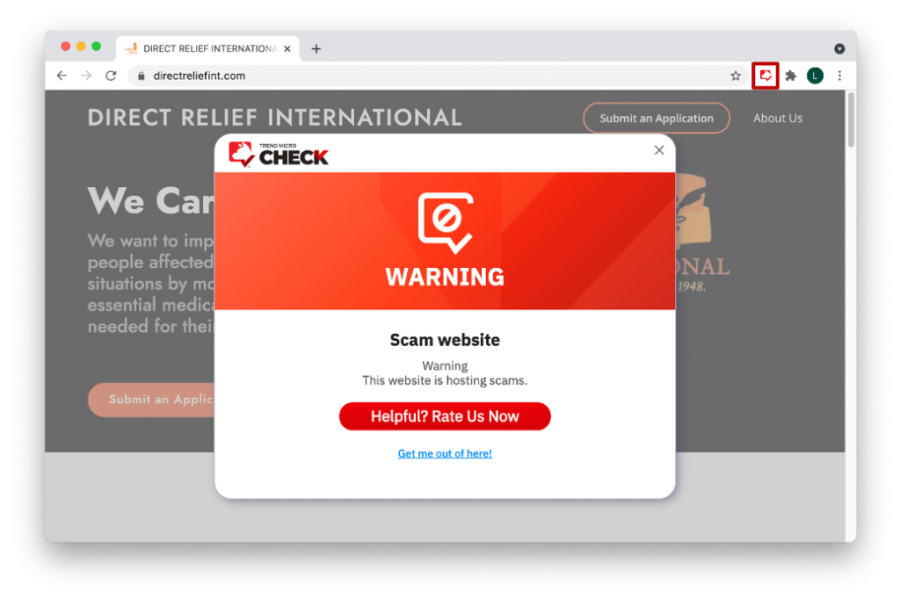
- Install Trend Micro Check for free for bulletproof on-the-go protection against scams. It detects and blocks dangerous websites automatically:
If you found this article helpful, please share it and spread the word!
This article is fromTrend Micro.
Report a Scam!

Have you fallen for a hoax, bought a fake product? Report the site and warn others!
Scam Categories
Help & Info
Top Safety Picks
Your Go-To Tools for Online SafetyDisclaimer: Some of the links here are affiliate links. If you click them and make a purchase, we may earn a commission at no extra cost to you.
- ScamAdviser App - iOS : Your personal scam detector, on the go! Check website safety, report scams, and get instant alerts. Available on iOS
- ScamAdviser App - Android : Your personal scam detector, on the go! Check website safety, report scams, and get instant alerts. Available on Android.
- NordVPN : NordVPN keeps your connection private and secure whether you are at home, traveling, or streaming from another country. It protects your data, blocks unwanted ads and trackers, and helps you access your paid subscriptions anywhere. Try it Today!
- Incogni : Incogni automatically removes your personal data from data brokers that trade in personal information online, helping reduce scam and identity theft risks without the hassle of manual opt-outs. Reclaim your privacy now!
Popular Stories
As the influence of the internet rises, so does the prevalence of online scams. There are fraudsters making all kinds of claims to trap victims online - from fake investment opportunities to online stores - and the internet allows them to operate from any part of the world with anonymity. The ability to spot online scams is an important skill to have as the virtual world is increasingly becoming a part of every facet of our lives. The below tips will help you identify the signs which can indicate that a website could be a scam. Common Sense: Too Good To Be True When looking for goods online, a great deal can be very enticing. A Gucci bag or a new iPhone for half the price? Who wouldn’t want to grab such a deal? Scammers know this too and try to take advantage of the fact. If an online deal looks too good to be true, think twice and double-check things. The easiest way to do this is to simply check out the same product at competing websites (that you trust). If the difference in prices is huge, it might be better to double-check the rest of the website. Check Out the Social Media Links Social media is a core part of ecommerce businesses these days and consumers often expect online shops to have a social media presence. Scammers know this and often insert logos of social media sites on their websites. Scratching beneath the surface often reveals this fu
How do I recover my crypto after it’s stolen? What happens if your crypto wallet is compromised? Can stolen crypto be traced, and can police actually recover crypto in 2026? These are the questions most people ask within minutes of realizing their wallet has been drained. Crypto theft is fast, quiet, and unforgiving. By the time most victims notice something is wrong, the funds are already moving across the blockchain. Once seen as a problem for exchanges and whales, crypto theft now heavily affects everyday investors. Phishing links, fake support chats, wallet approval scams, SIM swaps, and malware attacks have become common. Knowing what recovery realistically looks like—and what it doesn’t—can prevent panic, bad decisions, and costly follow-up scams. In a Nutshell Crypto recovery is possible, but only in limited situations Blockchain transactions are irreversible, but stolen crypto can still be traced Speed and documentation matter more than optimism Police and exchanges play a bigger role than private recovery services Guaranteed recovery offers are almost always scams Is it Actually Possible to Recover Stolen Crypto? Yes, crypto recovery is possible, but only under specific conditions and rarely through direct action by the victim. Blockchain transactions are final by design. Once crypto is sent and confirmed, it cannot be reversed. There is no central authority, no chargeback process, and no technical “undo” button, even if the transaction was clearly fraudulent. This is where many people ask whether stolen crypto can be traced. In most cases, it can. Every transaction